Your internal clock
Circadian rhythms help coordinate when your body becomes more alert and when it prepares for sleep. Light, timing and daily routines all provide cues to this roughly 24-hour system.

Sleep is an active biological process, not simply the moment when your day switches off. Understanding a little about how it works can make bedtime feel less like a performance — and more like a transition.
Understand your sleep ↓Circadian rhythms help coordinate when your body becomes more alert and when it prepares for sleep. Light, timing and daily routines all provide cues to this roughly 24-hour system.
Across the night, you move through non-REM and REM sleep in cycles that usually repeat about every 80 to 100 minutes. Deep sleep tends to be more prominent earlier in the night, while REM periods generally become longer later.
Sleep supports many processes across the body and brain. Rather than staying in one state all night, the brain cycles through distinct stages with different patterns of activity. Learning that rhythm can help replace some bedtime myths with a more realistic picture of rest.
Persistent trouble falling asleep, staying asleep, or feeling rested can have many causes. When sleep problems are frequent or affecting daily life, it is worth discussing them with a healthcare professional.
NHLBI explains that a typical night usually includes four to six sleep cycles, with each cycle restarting roughly every 80 to 100 minutes.
Relaxation approaches — including breathing, progressive relaxation and guided imagery — are used within behavioral approaches to insomnia and can be part of a consistent wind-down routine.
A wind-down routine is less about performing a perfect list and more about giving your body and mind consistent signals that the active part of the day is ending.
Bright artificial light close to bedtime can work against the signals your body uses to prepare for sleep. Softer evenings can help mark the transition.
A few minutes of slower breathing, progressive relaxation or guided imagery can give your attention somewhere quieter to go.
A quiet, cool and dark environment is part of the sleep-habit guidance recommended by NHLBI and other sleep-health resources.
A reasonably consistent sleep and wake schedule helps reinforce the timing cues your circadian system uses every day.
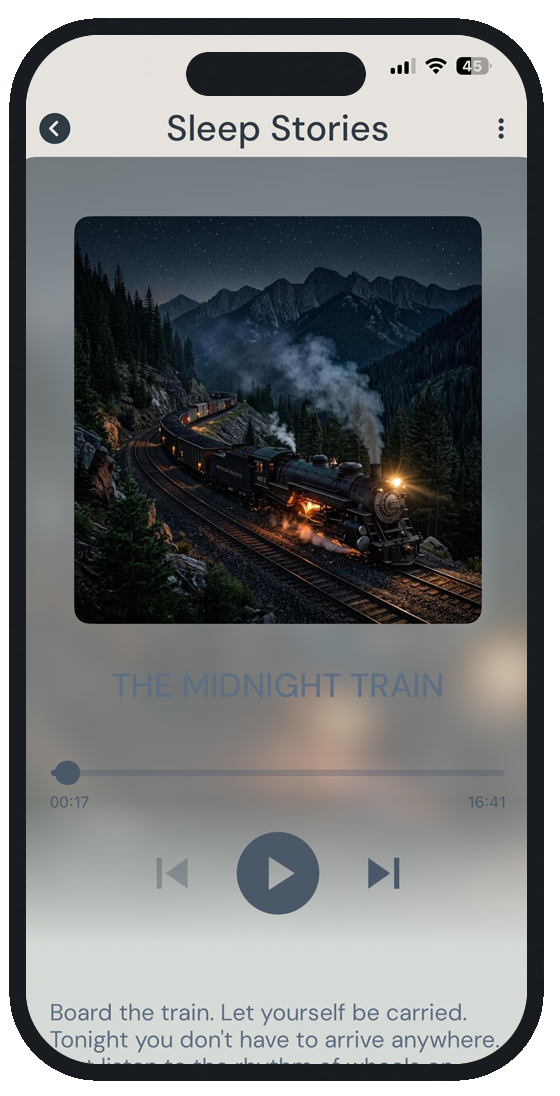
A bedtime story, quiet soundscape or simple ritual can become a boundary between solving, planning and doing — and resting.
Watching the clock and trying to force sleep can make bedtime feel like another task. Rest can begin with simply reducing stimulation and letting the night unfold.
Brief awakenings can occur between normal sleep cycles. What matters is the broader pattern, not one moment you happened to notice.
Sleep is not a switch you control directly. Routines and environment can support it, but trying harder is not always the answer.
Occasional restless nights happen. A persistent pattern — especially one that affects daytime functioning — is different and deserves attention.
Sometimes the mind needs somewhere gentle to go before it can let go.
A sleep story is not about concentrating hard or reaching the ending. It can offer a soft thread of attention — enough to step away from tomorrow's list, without asking you to solve anything.
For other nights, a guided meditation, calming soundscape or quiet music may feel better. The useful ritual is the one that helps your evening become less stimulating and more predictable.
Now brings together original sleep stories, guided meditations, relaxing music and calming sounds in English and Spanish — different ways to create a softer transition from day to night.