Meditation
Meditation is a broad family of practices that intentionally train attention or awareness. A practice may use the breath, sensations in the body, a word or phrase, sound, visualization, compassion, or open awareness as its anchor.


Meditation is a broad family of practices that intentionally train attention or awareness. A practice may use the breath, sensations in the body, a word or phrase, sound, visualization, compassion, or open awareness as its anchor.
Mindfulness is commonly described as bringing awareness to the present moment with less judgment. It can be practiced formally in meditation, but also while walking, eating, listening, working, or noticing a difficult emotion.
Meditation includes many approaches — guided practices, focused attention, compassion, repetition, open awareness and mindfulness among them. Research has studied several of these practices, with especially extensive evidence on structured mindfulness-based meditation programs. Across clinical studies, meditation has been associated with meaningful improvements in areas such as anxiety, depression, psychological stress and pain for some people.
The science is still evolving, and no single practice works the same way for everyone. Meditation can be a valuable wellbeing tool while complementing — not replacing — medical or mental-health care when that care is needed.
An NCCIH-cited analysis involving more than 12,000 participants found that mindfulness-based approaches performed better than no treatment for anxiety and depression and, in those studies, comparably to established evidence-based treatments.
A JAMA Internal Medicine review of 47 trials involving 3,515 participants found measurable improvements in anxiety, depression and pain from meditation programs — useful evidence that the practice can have effects beyond simply “feeling relaxed.”
These aren't rigid boxes, and traditions use different names. Think of them as a simple map of a much larger landscape.
Returning attention to one anchor, often the breath, a sensation, a sound, or another chosen point of focus.
Noticing thoughts, sensations and sounds as they arise, without needing to hold onto or push away each one.
Intentionally cultivating kindness, goodwill or compassion toward yourself and others.
Using physical sensations — such as a body scan or mindful movement — as a way of returning to present experience.
Using a repeated word, phrase or sound as the object of attention. Forms of this practice appear across different traditions.
Following spoken guidance through one or more techniques — often an approachable way to learn what a practice feels like.
Thoughts don't have to disappear. The practice may simply be noticing them and choosing where to place attention next.
A practice can be brief. Consistency and usefulness in your actual life may matter more than creating a perfect ritual.
Many practices have deep roots in spiritual and contemplative traditions. Today, meditation is also practiced in secular settings. People can approach it in ways that respect their own beliefs.
The practice doesn't have to end when the timer does.
A mindful moment might be noticing your shoulders tighten during an email, actually tasting the first sip of coffee, listening without preparing your response, or feeling your feet on the floor before a difficult conversation.
The point isn't to turn every moment into an exercise. It's to become a little more available for the life that is already happening.
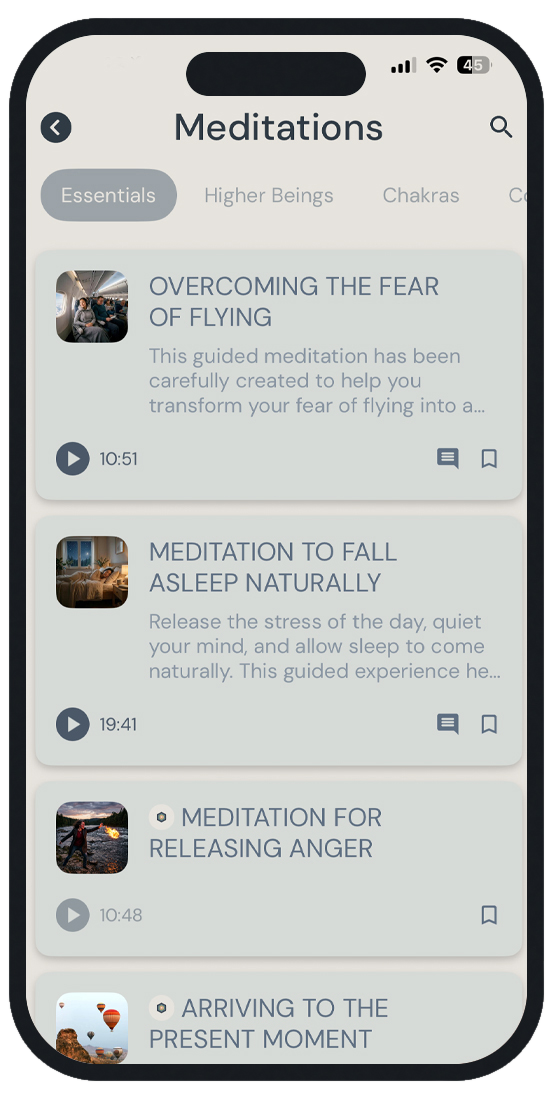
Now gives you guided meditation alongside breathwork, sleep, soundscapes and silence, in English and Spanish. Start short, explore different approaches, and keep what genuinely helps.