Outer quiet
This is the quieter environment around you: fewer voices, notifications and competing sounds. Reducing external input can make it easier to notice where attention goes when it is not constantly being pulled outward.

Our days are full of voices, alerts, music, traffic and information. Choosing a few quiet minutes does not mean escaping life. It can simply mean removing one layer of stimulation and noticing what remains.
Make a little room ↓This is the quieter environment around you: fewer voices, notifications and competing sounds. Reducing external input can make it easier to notice where attention goes when it is not constantly being pulled outward.
Inner quiet does not mean having no thoughts. It is closer to creating enough space to notice thoughts, sensations and emotions without needing to fill every moment with another stimulus.
A 2023 systematic review examined 37 studies on silence and the autonomic nervous system. The findings suggest that the experience matters: forms of inner silence were associated with reduced physiological stress activity, while unfamiliar external silence can sometimes increase alertness. In other words, silence is not a switch — context, familiarity and intention shape the response.
Research on silence is still developing. Quiet time is best understood as a practice and an environment, not a medical treatment or a promise that everyone will feel calm immediately.
The systematic review brought together research on both inner and outer silence and found that autonomic responses vary with the kind of silence and the circumstances in which it is experienced.
Neuroscience research on wakeful rest shows that the brain remains active when we are not doing a task. Resting-state networks are involved in internally directed activity, reminding us that a pause can still be mentally active.
There is no single correct way to spend a quiet interval. The structure can be as light as choosing a duration and deciding what you want to do with the space.
Choose a beginning and an end, then let the minutes be unfilled. A timer removes the need to keep checking the clock and gives the pause a simple container.
You do not have to control the breath. Simply noticing it can give attention a gentle place to return when the mind starts following a thought.
Notice contact with the chair, temperature, tension or movement. The body can provide an anchor without narration, music or a guided voice.
Outdoor quiet is rarely silent. Wind, birds and distant activity can become part of the practice when you listen without needing to label or follow every sound.
A few minutes without input between work and home, before sleep or after a difficult conversation can create a boundary between one part of the day and the next.
No special focus is required. Sit, walk or rest without adding content. Thoughts can come and go; the practice is simply not reaching immediately for the next thing.
A busy mind may become more noticeable when external stimulation drops. Noticing that activity is part of the experience; you do not need to force it away.
Most real-life quiet includes sound. The goal can simply be fewer intentional inputs — no podcast, no conversation, no scrolling — rather than laboratory silence.
A short pause can be meaningful. Consistency and a duration that feels workable may matter more than turning silence into another endurance test.
Not every empty moment needs to be filled.
Three quiet minutes before opening your inbox. Sitting in the car for a moment before walking inside. A silent Sunday morning. A pause after meditation instead of immediately reaching for your phone.
Silence can be less about withdrawing from the world and more about giving yourself a small interval in which nothing new has to enter.
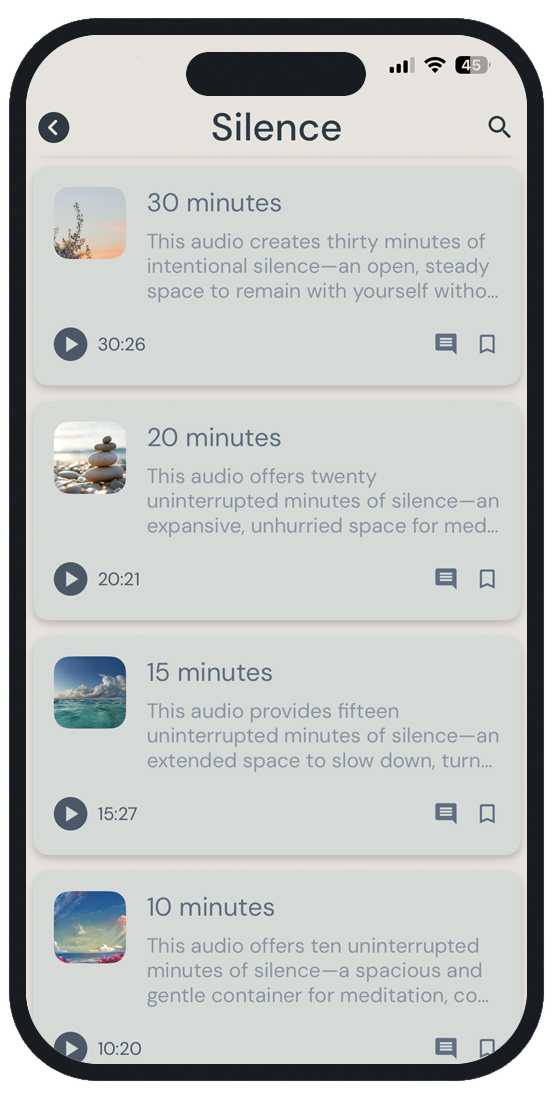
Now includes a simple silence timer alongside meditation, breathwork, soundscapes and sleep experiences in English and Spanish — so sometimes the practice can be guided, and sometimes it can be nothing more than time and space.